
Audit case | Baseline slices from five export websites: what locks AI out is usually your own firewall and template
In August 2026 five export-oriented businesses submitted their websites to our free checker. Their baseline audits failed in different places — every one invisible to the owner: firewalls mis-killing AI crawlers wholesale, template robots.txt rules barring them, Chinese-English twin sites that never declare each other, structures machines cannot read. This page publishes five anonymised slices and the export-subset methodology. None of the subjects is our client; with no authorisation, none is named.
Subjects and authorisation, stated up front. The five companies on this page are export-oriented businesses that submitted their own websites to our free AI-visibility checker in August 2026. The checker is anonymous — no sign-up, no email, no phone number — so none of them is our client, and we hold no publication authorisation from any of them. This page therefore differs from our named client cases: no company is named, and each slice states only a broad industry category, never a region. That continues a commitment we have published before: checker data is used for aggregate research and anonymised analysis, never to single anyone out.
This page also contains no results data. Our entire interaction with these five companies is the automated baseline audit the checker ran for each of them. What the audits found, what it means and where remediation would start — that is what this page covers; with no remediation there is no before-and-after.
Why write it up as a case at all? Because the five audits together form a remarkably complete cross-section of the AI-visibility problems of export websites: each company failed in a different place, and every one of those places is invisible to the site owner.
1. Who these companies are
The checker launched on 7 August 2026 and had received audits of 107 distinct URLs by 26 August. After removing 18 URLs we tested ourselves for the public case library and roughly 13 well-known public sites and test domains, genuine business and personal submissions came to about 76 URLs — of which 25 URLs, from roughly 19 organisations, were export-oriented: about a third.
Their testing behaviour is just as telling. The audit timeline contains four highly professional control tests: the same site tested on http and https (2 minutes apart); bare domain and www each tested once; Chinese and English sites tested back-to-back within 4 minutes; two sites of the same company tested 1 minute apart.
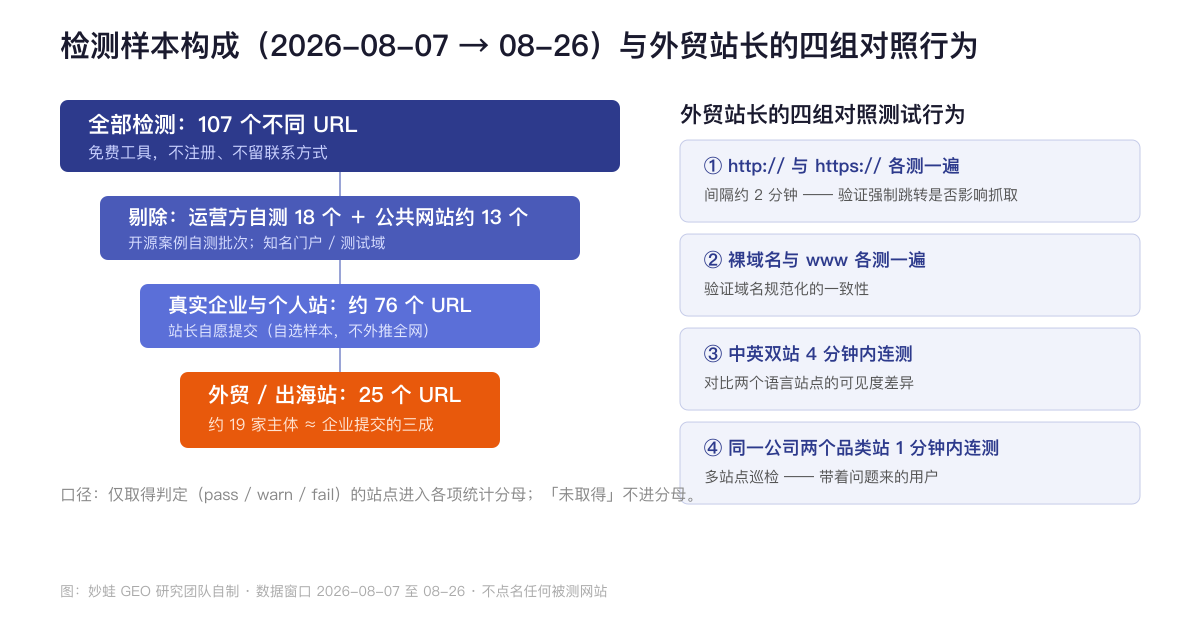
This is not idle traffic. These are people who arrived with a question — export site owners already believe overseas buyers are using AI to find suppliers, and they have started checking themselves. The five slices below show that even this most diligent group is paying for problems they cannot see.
2. Five slices: each diagnosis
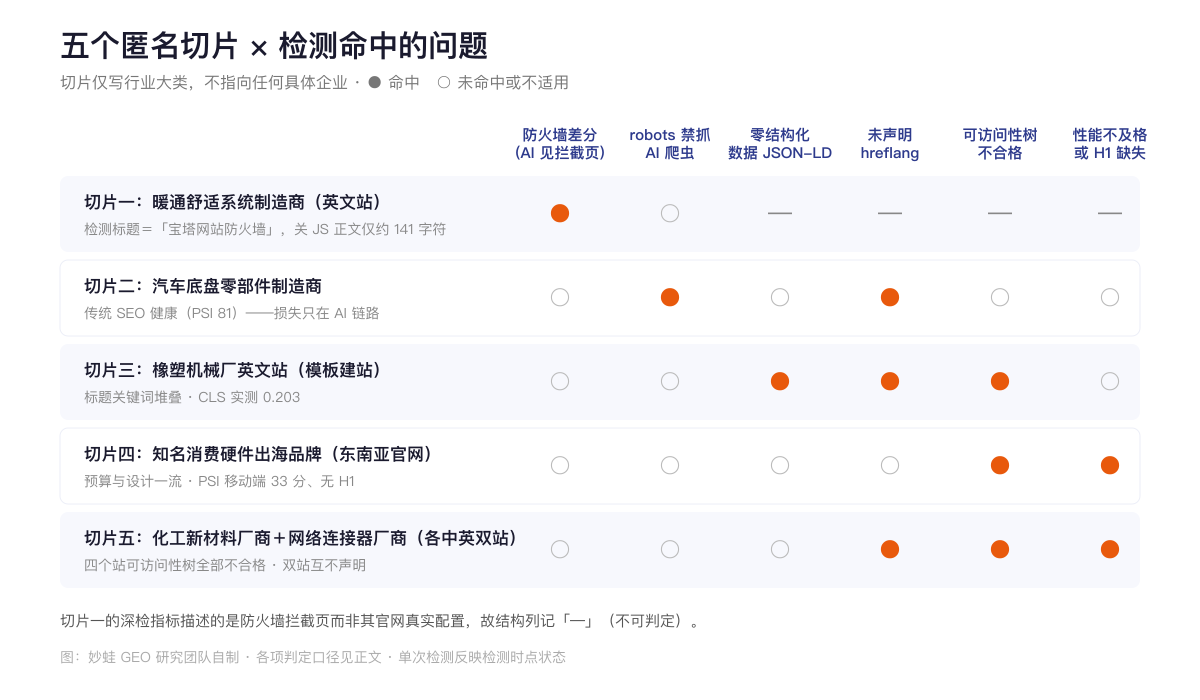
Slice one: what AI sees is not the website — it is the firewall
The first company manufactures HVAC comfort systems and tested its English site. The diagnosis was bizarre: the page title captured in the audit environment was the interception page of a server firewall product, and with JavaScript off the page body shrank to about 141 characters — like a company that never built a website at all. Yet open the site in an ordinary browser and everything is fine: full product lines, fluent English, polished design.
Neither view is wrong. What the audit node (an automated browser overseas) sees and what a buyer's browser sees are not the same page. The server firewall classifies overseas automated traffic as a threat and serves an interception page — and AI crawlers share almost every trait of the audit node: datacentre IPs, automation, overseas egress. In other words, every time an AI comes to read this site, what it most likely reads is that firewall page. The owner cannot know: the site always looks normal to them.
Nor is it an isolated case. In our previously published 86-site aggregate analysis, 12.5% of the 48 sites where the probe succeeded (6 sites) served different content to AI crawlers than to ordinary browsers.
Slice two: robots.txt bars AI from the whole site, while traditional SEO is fine
The second company manufactures automotive chassis components. Its traditional metrics are healthy: mobile PageSpeed 81, tidy titles and descriptions. But in robots.txt, the rules for ClaudeBot amount to disallowing the entire site, and the rules for Google-Extended do the same — the former affects retrieval by Claude, the latter affects how Gemini grounds its answers (traditional Google rankings are unaffected).
Our diagnostic judgement: configurations like this are rarely a deliberate business decision; they are the defaults of a site template, a security plugin or an anti-scraping tutorial. What makes them insidious is that traditional search traffic stays perfectly normal — the loss occurs only on the new AI-retrieval path, and no report will ever show it.
Slice three: every stock ailment of template-built export sites, none missing
The third is the English site of a rubber-and-plastics machinery factory, a textbook template-built export deliverable: a title in the "company name + product word + product word" pile-up style; no JSON-LD structured data anywhere on the site; an English site with no hreflang declared; a failing accessibility tree; and a measured Cumulative Layout Shift (CLS) of 0.203 while loading.
No single item is fatal, but together they mean: AI can fetch this site, yet what it reads is a heap of unstructured text blocks, with no idea which language of buyer to recommend it to. Not one of these items appears on a standard site-delivery acceptance checklist.
Slice four: budget is not the dividing line
The fourth is the Southeast-Asia site of a well-known consumer-hardware brand: mobile PageSpeed 33, not a single H1 on the entire home page, accessibility tree failing. Big brand, ample budget, beautiful design — yet at the machine-readability layer it is no different in kind from the template site above. AI visibility is not a by-product you get free with an expensive, beautiful site; it is a separate layer of engineering that needs its own acceptance testing.
Slice five: Chinese and English twin sites, same ailments, and they do not even acknowledge each other
The fifth slice is two companies — a chemical new-materials manufacturer and a network-connector manufacturer — that independently did the same thing: tested their Chinese and English sites back-to-back within minutes.
The results were strikingly consistent: all 4 sites fail the accessibility-tree check, and neither company's site pair declares hreflang — to a machine, the Chinese and English sites are two unrelated websites. AI does not know they belong to the same company, or which language version to show an overseas buyer. Each English site had its own gap besides: one had no H1, the other an incomplete Open Graph. Twin sites are standard equipment for exporters; twin-site mutual declaration is done by almost no one — the most export-specific pitfall in this batch of data.
3. The export subset in numbers (denominators throughout)
Merging the roughly 19 organisations into 18 primary sites (Chinese sister sites not double-counted; only sites with a verdict enter each denominator):
- Accessibility tree: 10 of the 16 sites with a verdict fail (62.5%) — almost identical to the 64% of our 86-site full sample (46 of 72). This is an industry-level problem, and export sites get no exemption;
- hreflang: 6 of 14 sites with a verdict declare none — businesses built on multilingual trade that never tell machines how their language versions correspond;
- Open Graph: 3 of 14 entirely missing, 3 incomplete; H1: 3 of 14 missing; JSON-LD: 2 of 14 with none at all;
- Mobile PageSpeed: 2 of the 16 scored sites failing (33 and 45), 12 in the warning band;
- robots vs AI crawlers: 1 of the 9 sites with a verdict disallows ClaudeBot site-wide;
- No-JavaScript body text and canonical each fail on 1 site (both caused by the firewall interception page of slice one, not that site's true configuration).
In one sentence: export sites share the same base ailments as the full sample (the structural layer is worst), plus three export-specific ones — firewalls mis-killing overseas automated traffic, template robots rules barring AI crawlers, and multilingual twin sites that never declare each other. What they share: the owner can never see any of it.
4. Where remediation would start
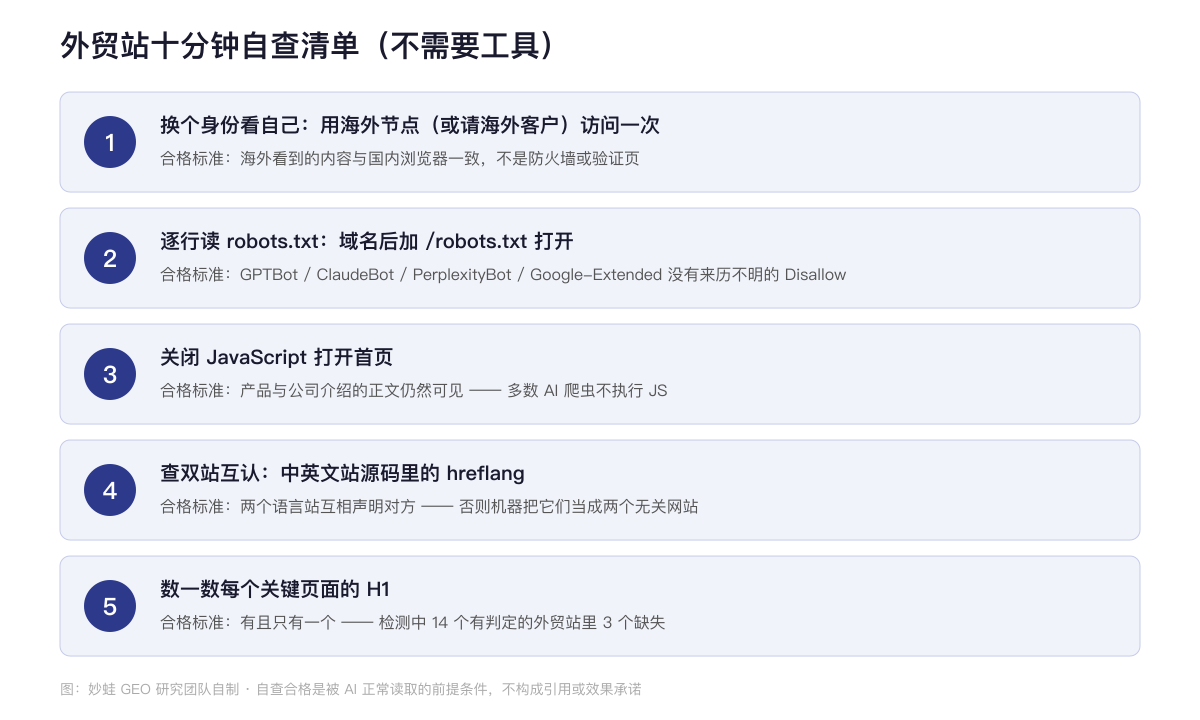
These five companies are not our clients, so what follows is not a delivery record but the direction their audits point to — five things any similar business can do before spending anything:
- Look at yourself from outside: visit your site from an overseas node (or ask an overseas customer to) and compare against what a domestic browser shows — the firewall page in slice one can only be discovered this way;
- Read robots.txt line by line: look for Disallow rules against GPTBot, ClaudeBot, PerplexityBot and Google-Extended — rules you cannot explain are most likely template defaults;
- Open your home page with JavaScript off: see how much body text remains — most AI crawlers do not execute JS;
- Check twin-site mutual declaration: whether the Chinese and English sites carry hreflang tags pointing at each other;
- Count the H1s: every key page should have exactly one.
What the list cannot cover — the accessibility tree, structured data, user-agent differential probing — needs tooling. That is exactly why our checker is free: no sign-up, no contact details, report on completion.
5. Boundaries
As usual, what this page cannot prove: the sample is self-selected (owners who choose to test already care about AI visibility), so none of the proportions extrapolate to the export industry as a whole; the audits measure technical readability and neither predict nor promise any AI citation, indexing or traffic outcome; a single audit reflects the site only at the moment of testing; this page names no audited website, the slices are de-identified, and every slice's pattern was observed in more than one site of the same-period export sample — any resemblance to a specific company reflects how common these problems are; none of the five subjects is our client, and this page constitutes no endorsement of us by any of them.
About us: Miaowa GEO is a generative engine optimisation (GEO) product of Tianjin Sibide Technology Co., Ltd., founded in 2026 (unified social credit code 91120223MAKH9RTU1Q), serving exporters, cross-border e-commerce companies and global brands. Our business is monitoring and improving how brands are mentioned and cited in AI search. We do not represent any third-party AI platform, and we promise no indexing, fixed rankings, traffic or revenue.
Data source: aggregated records of Miaowa GEO's free checker from 7 to 26 August 2026, together with the public testing capabilities of Google PageSpeed Insights and Lighthouse. The full-sample methodology is described in our previously published 86-site aggregate analysis.
Written by the Miaowa GEO research team, with AI assistance for source collation and copy-editing; all facts, sources and conclusions were reviewed by humans.
Subjects and authorisation
- Relationship
- All five subjects are anonymous users of the free checker, not Miaowa GEO clients. We hold no publication authorisation from any of them, so none is named and each slice states only a broad industry category. This page constitutes no endorsement of us by any subject.
- De-identification
- The slices are de-identified: broad industry category only, no region, no identifiable page text quoted. Every pattern described was observed in more than one site of the same-period 25-URL export sample — each slice describes a category of problem, not one company.
- Audit window
- 7 Aug 2026 – 26 Aug 2026