
Case study | From having content to entering AI procurement shortlists: how SupplyICs built GEO growth
After one phase of GEO optimisation, SupplyICs began entering supplier candidate lists in unbranded procurement questions on several AI products. Organic traffic subsequently increased, and an email connection ultimately led to a completed sale. This case discloses the diagnosis, remediation method, selected AI-answer samples and attribution limits.
What outcome does a B2B company actually want from GEO?
It is not typing its own brand name into an AI product and receiving a company description. Nor is it a high-looking score with no clear business meaning. The useful change is this: when a prospective buyer does not know the brand and describes only a sourcing need, does AI put the company into the candidate set? When the buyer investigates further, can AI find enough evidence to explain why the company deserves consideration?
SupplyICs is a brand serving electronic-component procurement, with a focus on end-of-life components, shortage parts, and Xilinx and Altera FPGA sourcing. After one phase of GEO remediation, our observations across real procurement questions on several AI products showed SupplyICs beginning to enter some supplier shortlists and being described as a specialist in EOL, shortage and FPGA procurement.
The change then moved beyond whether AI mentioned the brand. The client confirmed a corresponding increase in organic traffic after the optimisation. A prospective buyer made contact by email and later completed a purchase.
This case is not an attempt to turn one sale into a promise that GEO guarantees customers. Its purpose is to show what happened in between: how we started with the buyer's sourcing questions and reorganised positioning, content and evidence so that AI could understand SupplyICs more clearly — and so that buyers with a real need could find and contact it more easily.
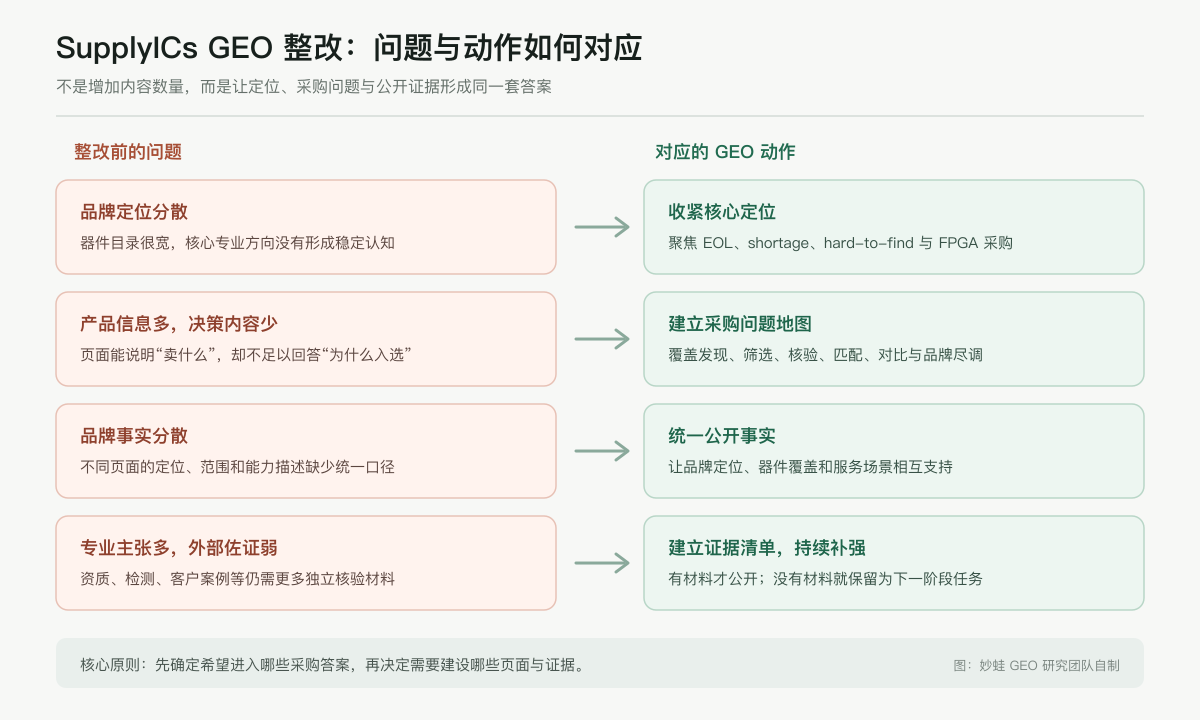
1. Before remediation: the site had content, but not a clear reason to shortlist it
SupplyICs did not start with an empty website. It already had product information, procurement knowledge and industry content. The problem was that the material did not consistently answer several questions shared by AI products and procurement teams.
1.1 The positioning was not concentrated enough
Electronic-component catalogues are naturally broad. A website may cover FPGAs, MCUs, memory, power management and interface components at the same time. Unless it states its core service scenario clearly, AI may see little more than another component website.
SupplyICs is most differentiated in EOL, shortage and hard-to-find sourcing, particularly for Xilinx and Altera FPGAs. Those signals existed before remediation, but they did not yet add up to a sufficiently stable and concentrated brand position.
1.2 Product coverage did not yet cover the buying decision
Procurement teams ask more than “what is this product?” They also ask:
- Which suppliers can handle discontinued or severely constrained parts?
- Which suppliers belong in an initial Xilinx and Altera FPGA candidate pool?
- What are the relative risks of independent distribution and authorised channels?
- How should authenticity, lot traceability and inspection capability be verified?
- Can the supplier serve the United States, Europe, Asia and other target markets?
- Do its warranty, returns, logistics and emergency-sourcing capabilities fit the requirement?
If a site answers only product specifications and not these decision questions, AI can crawl the pages without finding a sufficient reason to recommend the company.
1.3 Self-description outweighed independently verifiable evidence
A brand can describe its services, experience and quality system on its own pages. Procurement due diligence, however, does not rely on the supplier's account alone. During delivery, several AI answers showed the same limitation: they could identify SupplyICs' specialist direction, but stronger external support was still needed for corporate registration, certification status, third-party assessments and public customer cases.
The brand had partly answered “what do we provide?” but not fully answered “why should others trust us?” The former affects discovery; the latter affects recommendation and final qualification.
2. We did not begin with keywords; we rebuilt the procurement-question map
The first step was not mass article production. It was breaking down the sourcing decision in which SupplyICs might appear.
We built a Prompt Map around six stages:
- Supplier discovery: the buyer names no brand and describes only an EOL, shortage or FPGA need;
- Shortlisting: AI is asked for suppliers worth taking forward for quotation and verification;
- Qualification: traceability, testing, public credentials and authenticity risks are checked;
- Commercial fit: regional coverage, after-sales support, returns, warranty and delivery are compared;
- Supplier comparison: independent distributors, authorised channels and comparable providers are assessed;
- Brand due diligence: SupplyICs' business claims, public evidence and risks are checked directly.
The same question set was sampled through the product interfaces of ChatGPT, Perplexity, Gemini, Claude, Microsoft Copilot and Google AI Overview. We recorded the answer text, whether the brand appeared, whether it entered a shortlist, the cited sources and any limitations stated by the platform.
The point is simple: first decide which real buyer questions the company should enter, then decide which answers the website must provide. Reversing that order easily creates a large volume of relevant-looking content that never reaches the buying decision.
3. The core remediation: turn brand claims into extractable procurement answers
3.1 Tighten the positioning
We concentrated SupplyICs' core semantics around related sourcing scenarios:
- EOL and discontinued components;
- shortage components;
- hard-to-find part numbers;
- Xilinx and Altera FPGA lifecycle and alternative sourcing;
- continuity of supply for long-lifecycle industrial equipment.
This was not keyword repetition. It meant aligning the home page, company information, service descriptions, topic content and product information behind the same position.
3.2 Expand from product catalogue to procurement-decision content
The gaps exposed by the Prompt Map shaped content that answered what procurement teams actually ask: how to respond to obsolescence, compare suppliers, vet independent channels, prepare an RFQ, and understand sourcing risks across component families.
This content serves two readers at once. Procurement teams can use it to make a decision, while AI can more reliably extract structured, bounded answers from it.
3.3 Replace scattered facts with consistent facts
A common GEO problem is that the same brand uses different descriptions of its position, service scope and capabilities on different pages. Each page may look reasonable in isolation, but together they make it difficult for AI to determine which account is reliable.
During remediation, the stable public facts were aligned: what kind of supplier SupplyICs is, which sourcing problems it focuses on, which component categories it covers, which application scenarios it serves, which capabilities are public claims, and which still require further proof.
3.4 Do not hide evidence gaps
We did not interpret GEO as making every page sound more certain. In electronic-component procurement, excessive certainty can increase risk.
For certifications, testing, traceability, warehousing, customer cases and industry recognition, the rule was straightforward: publish what can be verified; keep anything unsupported on the evidence backlog. Cautious comments in AI due-diligence answers were retained to guide the next phase.
Entering a shortlist is not the same as passing supplier qualification. Being described by AI as a specialist is not the same as having earned every procurement team's trust.
4. What changed in AI answers after the optimisation
In the unbranded procurement questions retained during delivery, SupplyICs no longer appeared only when its brand name was searched directly.
Sample 1: shortlisted for EOL and shortage sourcing
When Microsoft Copilot was asked to shortlist several suppliers specialising in EOL and shortage semiconductor sourcing from public information, SupplyICs entered the candidate set. The answer described it as an independent supplier focused on EOL, shortage semiconductor and FPGA sourcing, and associated it with industrial automation, communications, automotive and mission-critical applications.
The brand had not been supplied in the question. It earned an answer position while competing with other suppliers.
Sample 2: included in an initial Xilinx and Altera FPGA supplier pool
In a question asking for an initial supplier pool for discontinued Xilinx and Altera FPGAs, Copilot included SupplyICs and used its EOL, shortage and FPGA direction as the reason.
ChatGPT also included SupplyICs in the candidate range, but advised further due diligence before a decision. That is not a negative result to remove. It identifies the next priority accurately: the specialist direction can be understood, while independently verifiable trust evidence still needs strengthening.
Sample 3: understood as a specialist in legacy industrial components
In a sourcing question for an industrial-equipment manufacturer covering FPGAs, memory and power-management components, Google AI Overview associated SupplyICs with legacy industrial IC, FPGA and microcontroller sourcing, and referred to its inspection and handling claims.
This remains one answer produced by a particular product interface for a particular question set. It is not a permanent ranking or a certification by the platform.
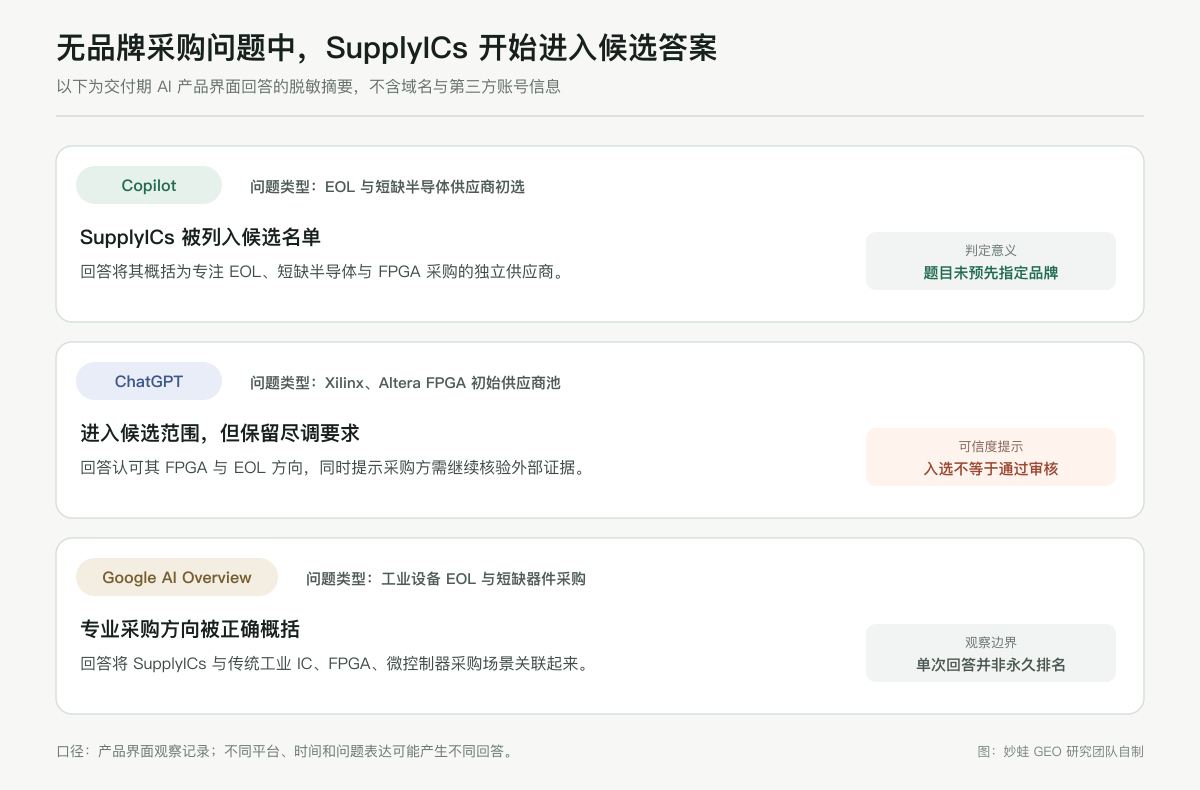
Together, these samples show more than crawling. SupplyICs' positioning had started to enter the way AI products organised final procurement answers: sometimes as a mention, sometimes as a candidate, and sometimes as a reference point for a specific sourcing judgement.
5. The result did not stop at the AI answer
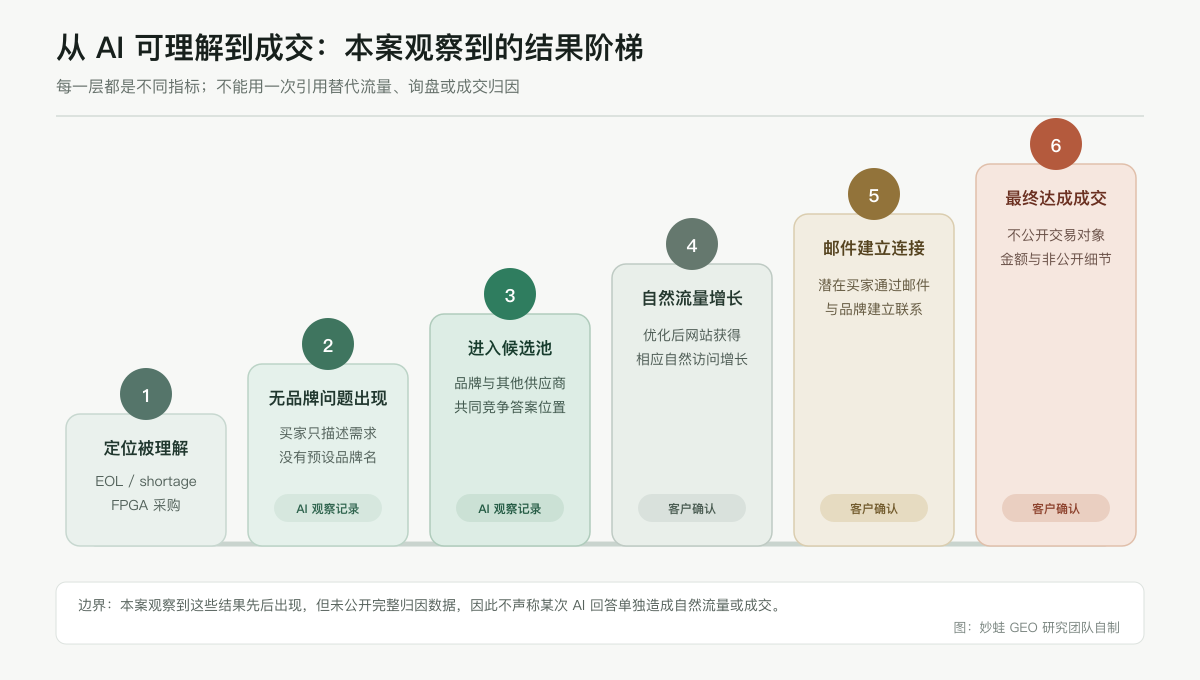
The client confirmed that the website received corresponding organic-traffic growth after this phase of GEO optimisation. A prospective buyer then contacted SupplyICs by email and ultimately completed a purchase.
This is the most important result in the case — and the one that requires the most careful interpretation.
What we can establish is that GEO remediation was implemented, followed by observable changes in AI visibility, organic traffic and an email-originated sale. Because this page does not disclose analytics, email content, customer identity, transaction value or the complete attribution path, we do not claim that one AI answer directly caused the order or extrapolate one purchase into a fixed conversion rate.
The accurate statement is: this GEO work improved the brand's visibility in some AI procurement answers and was accompanied by observable organic and business outcomes. For an export B2B company, that matters more than a standalone GEO score.
6. What this case actually validates
6.1 A smaller brand can enter unbranded AI procurement answers
The route is not endless repetition of the brand name. It is expressing a specialist position in the language buyers use and providing pages clear enough to support that position.
6.2 Content volume is not the only variable
Product catalogues cover part numbers and industry articles cover questions. But whether AI will shortlist a company often depends on positioning, content structure, factual consistency and trust evidence acting together.
6.3 GEO must measure both the answer layer and the business layer
Being crawled, cited, mentioned, recommended, visited and converted are different stages. A project should not report only whichever stage looks best.
SupplyICs merits a case study not because we captured an attractive AI answer, but because the change continued into organic visits, email contact and an actual transaction.
6.4 A credible review keeps the unresolved issues
SupplyICs still needs stronger third-party corroboration, verifiable credentials, public customer evidence and more stable cross-platform performance. Publishing these gaps does not weaken the case; it shows ongoing optimisation rather than one-off packaging.
7. Four self-checks for export B2B companies
If you want your company to enter AI supplier answers, start with four questions:
- When you omit the brand name and describe only the sourcing requirement, does AI mention you?
- When AI mentions you, is the reason the position you actually want to establish?
- Which pages support the facts AI cites, and can a procurement professional verify them?
- From AI visibility through organic visits, enquiries and purchases, have you retained an auditable attribution trail?
If the first answer is zero, solve discovery. If the brand is mentioned but AI has no reason to recommend it, improve positioning and content. If the company enters candidate pools but repeatedly receives a due-diligence caveat, the next priority is independent business evidence, not more articles.
8. Boundary: one sale is not a performance guarantee
This is one delivery case involving an electronic-component supplier. It does not establish the same outcome for other industries, websites or observation windows. AI answers vary by platform, time, retrieval state, wording and sampling; one answer is not a permanent preference.
The organic-traffic increase, email contact and purchase were confirmed by the client, but the complete attribution data are not public. We therefore do not attribute them to one page, citation or platform. Nor do we promise that GEO work will produce indexing, fixed rankings, enquiries or purchases.
What this case does support is narrower: rebuilding positioning, content and factual evidence around real procurement questions can improve a company's chance of entering AI procurement answers; when that visibility is paired with a clear conversion path, it may contribute to organic visits and real business connections.
About us: Miaowa GEO is a generative engine optimisation product of Tianjin Speed Tech Co., Ltd. for exporters, cross-border e-commerce companies and global brands. Its workflow includes Prompt Map, multi-model sampling, Truth Pack fact verification, source attribution, action planning and re-testing. We do not represent any third-party AI platform and promise no indexing, fixed ranking, traffic or revenue.
Data sources: the GEO delivery report provided by Miaowa GEO to SupplyICs, the AI product-interface observation records retained during delivery, and the client's confirmation of organic traffic, email contact and a completed purchase. The public scope excludes the client's domain, operating entity, transaction counterparty, transaction value and non-public business data.
Written by the Miaowa GEO research team with AI assistance for source collation and language editing. Facts, sources and conclusions were reviewed before publication.
Authorisation and review
- Authorised on
- 21 Aug 2026
- May be named
- Yes
- Logo permitted
- No
- What the client checked
- Only the SupplyICs brand name is public. The domain, operating entity, transaction counterparty and transaction value remain private. The approved scope includes pre-remediation issues, selected AI-platform answers, and client-confirmed organic-traffic growth, email contact and a completed sale.