
Case study | The product is real, AI only half believes it: finding the three pieces of evidence missing from a solar bird-mesh factory's export marketing
Sailin is a real solar bird-guard-mesh manufacturer in Anping, Hebei: a complete product system, OEM capability, pages written in the buyer's own language — and Perplexity and Google AI Overview already cite it. Yet in unbranded overseas-buyer prompts it appears in 4 of 14 answers while the category leader appears in 10 of 14. The gap is not the product but three pieces of unpublished evidence. This is Miaowa GEO's first client-authorised public case: how the baseline was measured, where the gaps are, and how 90 days of remediation will close them — methodology fully disclosed.
Authorisation note: The subject of this case, Sailin (product site BirdGuardMesh, birdguardmesh.com, operated by Anping Fangyi Wire Mesh Products Co., Ltd.), is a paying client of Miaowa GEO. This case is published with the client's authorisation.
This page contains no results data. The project started on 18 August, the baseline report was delivered on 20 August, and remediation has only just begun — writing about "results" now would be exactly the kind of unqualified claim we have criticised many times. What this page covers is the first half of the story: a genuinely solid factory, why it receives only half the credit it deserves in overseas AI answers, and what exactly the missing half is. The post-remediation re-test will be published as part two, whatever it shows.
1. Who this factory is
Sailin is based in Anping, Hebei — the heart of China's wire-mesh manufacturing belt. It is a registered manufacturer, not a trading shell, focused on one highly vertical export category: solar panel bird guard mesh, the rolls and installation kits that close the gap between rooftop solar arrays and the roof surface to keep birds from nesting underneath.
The product system is genuinely complete: three materials (PVC-coated steel, PVC-coated stainless steel and bare 304 stainless steel); matching hook wires, retaining discs, aluminium and nylon clips and C-type quick clips; sold both as mesh-only rolls and as complete kits; serving solar installers, pest-control suppliers and importing distributors across North America and Europe, with OEM private-label supply. Its English pages speak the buyer's own language — material grades, mesh heights, roll lengths, clip compatibility.
This is a factory that has done its homework. That was also our read when we took the project on: its problem is not the quantity of product content — it lies elsewhere, and locating it is precisely what the baseline measurement is for.
2. What we did first: measuring how AI sees it
The method is the one we have published before. The full methodology: 29 fixed English prompts, layered across the six stages of an overseas buyer's sourcing decision (supplier discovery → shortlisting → qualification → commercial matching → supplier comparison → brand due diligence); four platforms — ChatGPT, Gemini, Perplexity and Google AI Overview — via the product interfaces rather than APIs; 128 test slots, 106 complete answers obtained. Two judging rules: appearing in a source card does not count as being recommended, and slots that failed to run are recorded as not-run, never as zero.
The most telling prompts are the unbranded supplier-discovery questions: they never mention the client's name and never pre-load its unique selling points — they simply ask, in a buyer's words, who to consider in this category. What they measure is whether the factory shows up when an overseas buyer describes a need.
3. The baseline: AI has started to believe it — but only half-way
The good half first. Across 14 valid answers, Sailin's brand site appeared 4 times (28.6%), placing it in the second tier of broad discovery for this category. For a recently launched Chinese factory brand site that is not a given — it means the product-language coverage of its pages passes, and Perplexity and Google AI Overview can already read and cite it.
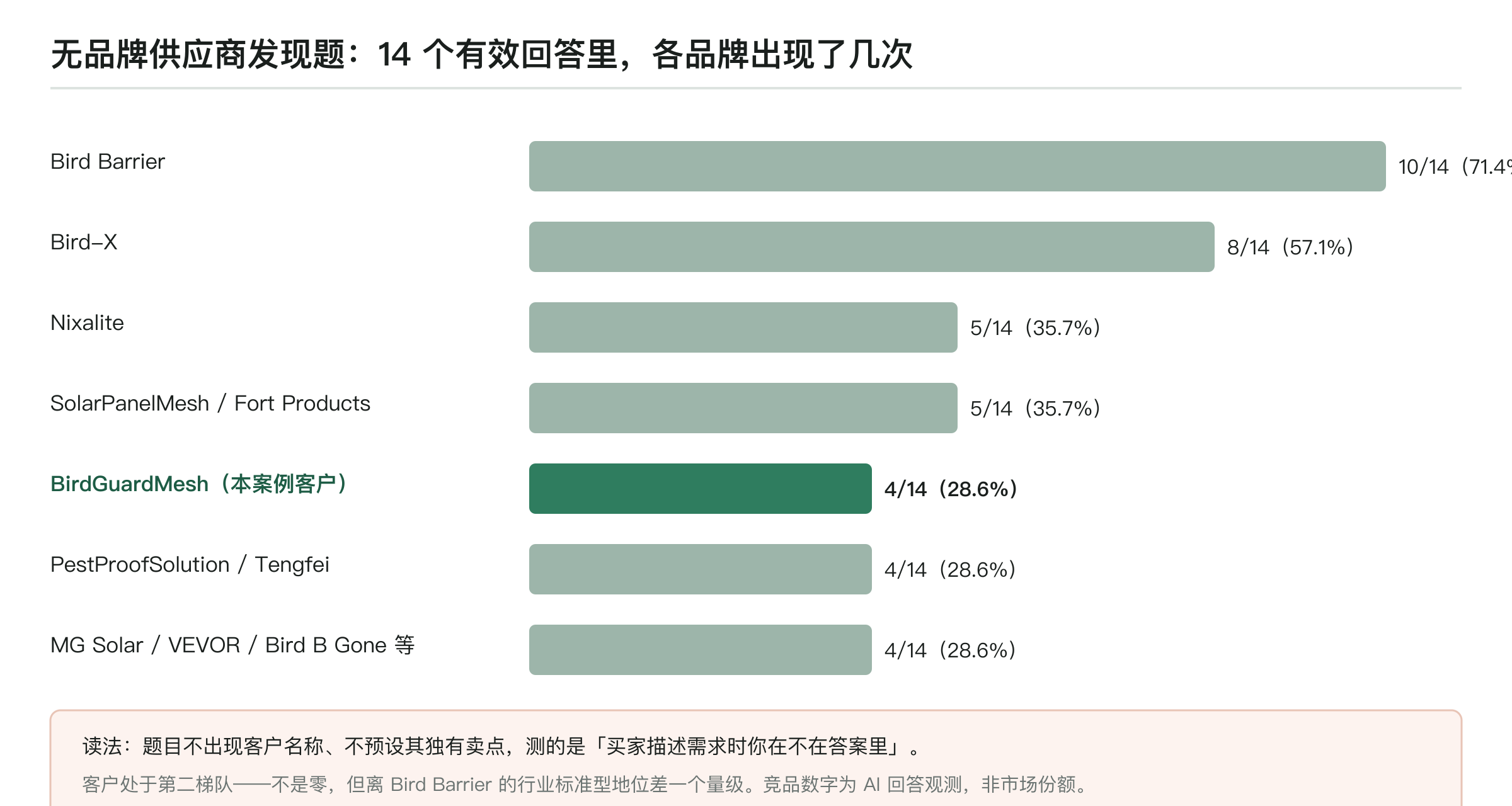
Now the other half. In the same batch, the category leader Bird Barrier appeared in 10 of 14 answers and Bird-X in 8 of 14. To be clear: competitor figures are observation counts from AI answers — not market share, and no judgement of their products. But the gap itself is real: when a buyer asks the same question, the leading brands are more than twice as likely to be mentioned as Sailin.
The platform split exposes the problem more sharply:
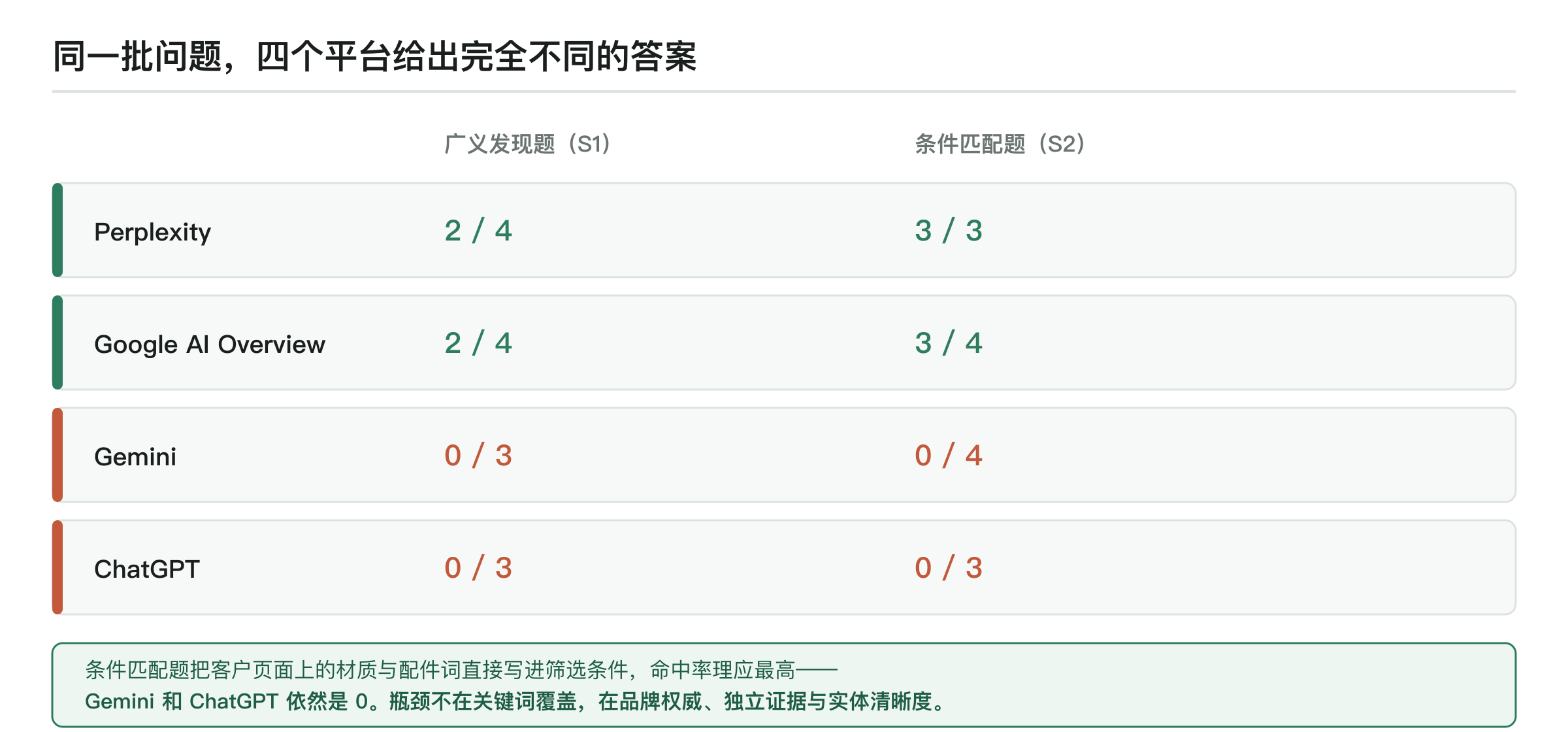
All 4 appearances came from Perplexity and Google AI Overview; Gemini and ChatGPT produced none.
We then ran a deliberately easy control: attribute-matched prompts that write the material and fitting vocabulary from Sailin's own pages straight into the constraints — PVC-coated steel mesh, 304 stainless, hook wires, retaining discs. Its hit rate duly rose to 6 of 14, with Perplexity at 3 of 3. Yet Gemini (0/4) and ChatGPT (0/3) stayed at zero.
That control rules out the most common self-misdiagnosis among exporters: this is not a keyword problem, and not a content-volume problem. When prompts overlap this closely with the page vocabulary and two platforms still return nothing, the bottleneck is somewhere else.
4. What is holding it back: three kinds of evidence not yet made public
After walking through all 106 answers and every source AI cited, the gaps converge on three things — and note that the factory has all three; they simply have not been translated into public evidence AI can verify:
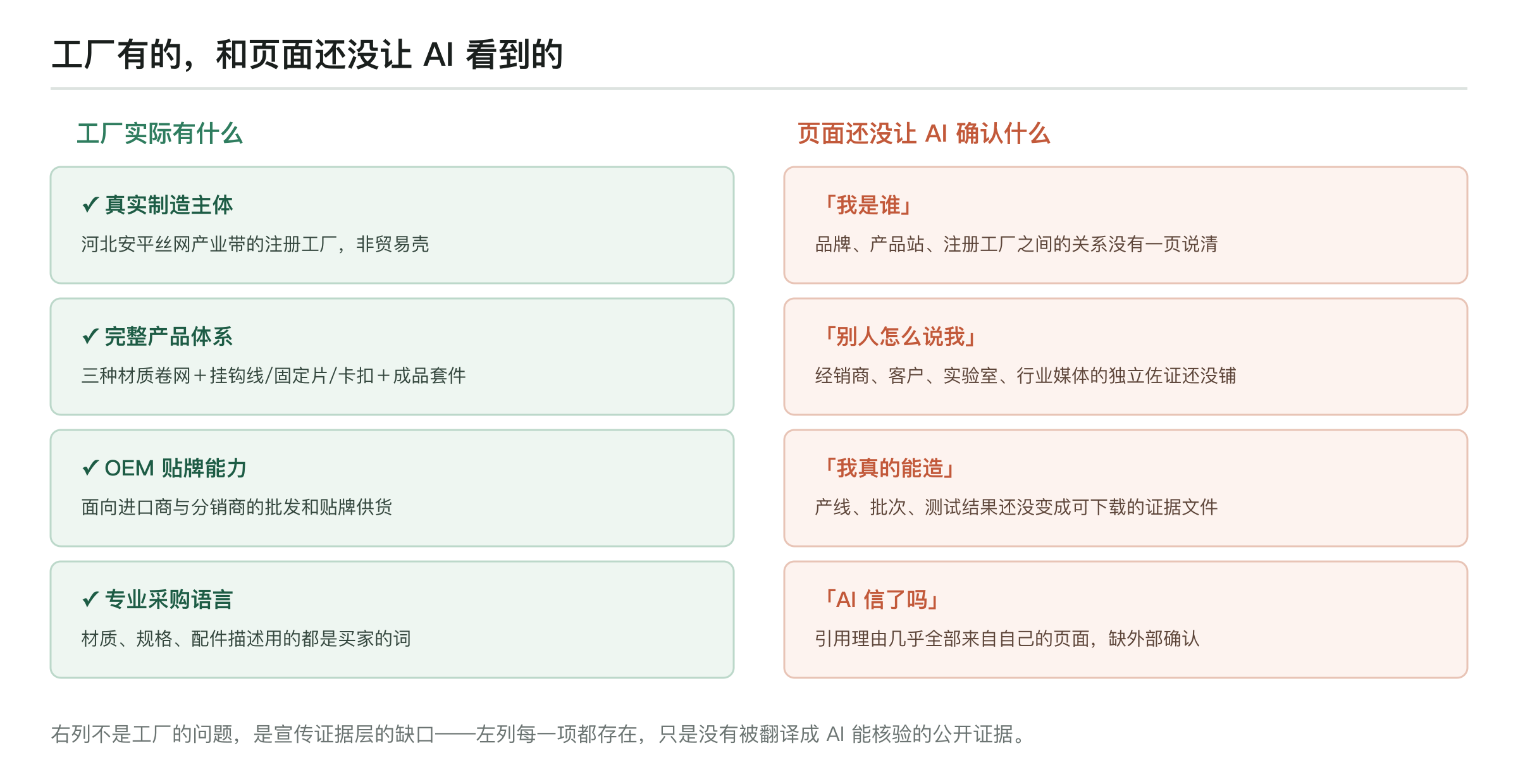
First: "who we are" is not stated on any single page. The relationships between the brand name, the product site and the registered factory are scattered across the site, and AI cannot assemble a definite answer. The factory is real, but if AI cannot confirm who is doing the manufacturing, it will not write "source manufacturer" into an answer. We also observed a platform-level phenomenon worth recording: when entity information is unclear, Gemini treats the site's self-description as "verified" and fills in the rest itself — this time it happened to fill in the right direction; next time it may not, and neither outcome is under the factory's control.
Second: "what others say about us" has not been built out. The reasons AI currently cites Sailin come almost entirely from its own pages. Independent distributors, customer references, laboratory reports, trade media — all still blank. The control group shows exactly why this matters: Bird Barrier's 10 of 14 rests on being the brand AI can most easily prove from external evidence. In the AI era, saying something about yourself a hundred times is worth less than someone else saying it once.
Third: "we really manufacture" has not become files. The pages can describe materials and specifications, but production lines, batches and test results have not been turned into downloadable technical documents. These are precisely what overseas buyers check during due diligence — and AI checks them faster. When nothing can be found, "manufacturer" remains a narrative claim.
Together these form the core finding of this case: Sailin's product passes AI's bar; it is stuck at the evidence layer. That is not a flaw in the factory — it is a flaw in how the factory presents itself, and presentation can be fixed systematically.
5. The next 90 days
The remediation roadmap has been delivered to the client, in four phases (the specific page-level checklist is client work product and stays private):
- Days 1–14 — make "who we are" clear: one page that settles the brand-to-manufacturer relationship, with information aligned across the site;
- Days 15–30 — turn "we really manufacture" into files: evidence pages and downloadable technical documents covering the factory, its qualifications, production processes and product testing;
- Days 31–60 — upgrade content into answers: supplier comparisons, material comparisons, installation and compliance content, with structured data;
- Days 61–90 — build "what others say about us", then re-test: develop independent third-party sources, then re-test all four platforms with exactly the same 29 prompts and the same platform configuration, at least 5 runs per platform.
Running the re-test on identical methodology is the only thing that makes before and after comparable — the results will be published as part two of this case, including whatever does not look good.
6. Three self-checks for factories like this one
Sailin's gaps are not unusual. In our observation, most exporting factories are stuck on the same three things. Before spending anything, check:
- Open your English site and look for one page that would let a stranger (or an AI) confirm how your brand, your website and your registered factory relate;
- In English, in a buyer's voice, without naming your brand, ask ChatGPT and Perplexity who to consider in your category — see whether you appear, and whose pages AI cites;
- Count the technical evidence files a buyer can download from your site (test reports, spec sheets, certifications) — files, not product photos.
If you cannot answer two of the three, your position is probably the same as Sailin's baseline: the goods are good; the evidence has not caught up.
7. Boundaries
As usual, what this page cannot prove: this is a single baseline of 14 valid answers — an order-of-magnitude reference, not a precise measurement, and generative answers fluctuate; the existing 4 appearances are the result of the client's own site work and have nothing to do with us — our work starts with the remediation, and any effect will be judged by the like-for-like re-test; platform differences do not extrapolate to other businesses; the 90-day roadmap is a work plan, not a guarantee — we promise no indexing, fixed rankings, traffic or revenue, and we will publish whatever the re-test shows.
About us: Miaowa GEO is a generative engine optimisation (GEO) product of Tianjin Sibide Technology Co., Ltd., founded in 2026 (unified social credit code 91120223MAKH9RTU1Q, ICP filing 津ICP备2026010121号), serving exporters, cross-border e-commerce companies and global brands. Our business is monitoring and improving how brands are mentioned and cited in AI search. We do not represent any third-party AI platform, and we promise no indexing, fixed rankings, traffic or revenue.
Data source: the August 2026 baseline report Miaowa GEO delivered to the client (128 test slots, 106 complete answers; observation records and the evidence package were delivered to the client with the report). The scope of client disclosure follows the case-publication authorisation between the two parties. The methodology has been published on this site.
Written by the Miaowa GEO research team, with AI assistance for source collation and copy-editing; all facts, sources and conclusions were reviewed by humans.
Authorisation and review
- Authorised on
- 20 Aug 2026
- May be named
- Yes
- Logo permitted
- No
- What the client checked
- Brand name, product-site domain and operating entity are named; baseline data, diagnosis and the remediation framework are published. The qualitative status “remediation complete, results observed” may be disclosed, while numerical outcome claims remain subject to a separately approved like-for-like re-test.